Jul 9, 2009

Budget Soup

The Senate Committee on Armed Services National Defense Authorization Act for Fiscal Year 2010 is now available online here. It's 350 pages and I haven't read it all, but here are some highlights:
Readiness in the technical base

The committee recommends $1.7 billion for readiness in the technical base, an increase of $10.0 million above the budget request. This account funds facilities and infrastructure in the nuclear weapons complex and includes construction funding for new facilities.

The committee recommends a decrease of $20.0 million in the Chemistry and Metallurgy Facility Replacement project (CMRR), Project 04–D–125, at the Los Alamos National Laboratory as a result of uncertainty in the design of the CMRR. The committee notes that the certification required to be made by the Defense Nuclear Facility Safety Board (DNFSB) and the National Nuclear Security Administration has not been made. The committee continues to believe that replacing the existing facility is essential but the CMRR has significant unresolved issues including the appropriate size of the facility. Some of these decisions will not be made until the Nuclear Posture Review is completed at the end of the year. The CMRR is one of two projects that the DNFSB has identified as having significant unresolved safety issues. These issues are associated with the project’s safety-related systems. Until such time as the safety basis documents are completed, the outstanding issues cannot be resolved. CMRR will be a category I facility supporting pit operations in building PF–4 and has a preliminary cost estimate of $2.6 billion. As stated last year the committee continues to support reconstitution of the pit manufacturing capability in PF–4 but urges that all safety issues with CMRR be resolved as soon as possible. If there is any change in the planned mission at CMRR, the committee directs the Secretary of Energy to notify the congressional defense committees.

The committee recommends an increase of $30.0 million for the Los Alamos Neutron Science Center (LANSCE) refurbishment, Project 09–D–007. The LANSCE is the only machine capable of performing nuclear cross section measurements of weapons materials to support the resolution of significant findings investigations. LANSE refurbishment would also further enhance the ability of the NNSA to perform surveillance on the stockpile.
[...]
Subtitle C—Other Matters
Ten-year plan for utilization and funding of certain Department of Energy facilities (sec. 3131)

The committee recommends a provision that would direct the Administrator of the National Nuclear Security Administration (NNSA) and the Under Secretary of Science (USS) at the Department of Energy to jointly develop a plan to use and fund, over a 10-year period, the National Ignition Facility at the Livermore National Laboratory, the Los Alamos Neutron Science Center at the Los Alamos National Laboratory, and the ‘‘Z’’ Machine at the Sandia National Laboratory. The committee notes that these three facilities are primarily funded and maintained by NNSA, but each of these has significant contributions to the science and energy research communities. The committee believes that the NNSA Administrator and the USS should explore how these unique facilities could be used and supported collaboratively to ensure that the capabilities of the facilities are fully utilized.

Review of management and operation of certain national laboratories (sec. 3132)


The committee recommends a provision that would direct the Secretary of Energy, in consultation with the Armed Services Committees of the Senate and the House of Representatives, to appoint an independent panel of experts to conduct a review of the management and operation of the Lawrence Livermore National Laboratory, the Los Alamos National Laboratory, and the Sandia National Laboratory.

The committee notes that several recent studies have focused on the organizational location of the three labs but not on their actual management and operations. The committee believes that the labs should remain under the Department of Energy, National Nuclear Security Administration, but believes that a review of the lab operations is timely.

Inclusion in 2010 stockpile stewardship plan of certain information relating to stockpile stewardship criteria (sec. 3133)

The committee recommends a provision that would direct the Secretary of Energy to include, in the annual stockpile stewardship plan for fiscal year 2010, an update on the stewardship criteria used to assess the safety, security, and reliability of the nuclear weapons stockpile. The last update of the criteria was completed in 2005. The 2010 plan would also include a review of each science-based tool, such as experimental facilities, developed or modified in the last 5 years.

The committee believes that as the stockpile ages and the total number of nuclear weapons in the stockpile decreases, the Department of Energy should articulate clear stewardship program going forward.

Reminder -Entrepreneurial Postdoc Fellow Appointment

This announcement went out to about a dozen LANL TSM's earlier this week. In the interest of ensuring a robust competition to select the very highest-quality postdocs for this new fellowship, I wanted to bring it to the attention of the wider community.
-Anonymous
------

From: postdocprogram@lanl.gov
Mon, 06 Jul 2009 14:47:02 -0600
Subject: Reminder -Entrepreneurial Postdoc Fellow Appointment

This is a reminder that the deadline to submit a candidate package for the Entrepreneurial Postdoc Fellow appointment is July 21st! We hope to receive a number of submissions!

Thank you!

_____________________________________________________________________________

Good afternoon!

Thank you for your interest in the development of a new Postdoctoral Fellow opportunity, the Entrepreneurial Postdoc Fellow. Many of you attended one of the two informational sessions offered and for those who attended, you were extremely helpful in providing input and suggestions which we have incorporated into our launch materials.

Sponsored by the Postdoc Program Office in coordination with the Technology Transfer (TT) Division, this new postdoc category will provide the opportunity to collaborate with LANL scientists and engineers who are performing research in areas that have strong potential for commercial applications. Special emphasis will be given to projects which could create a new business start-up in Northern New Mexico.

In addition to conducting research with their identified LANL technical PI/mentor, recipients of these fellow appointments will interact with Technology Transfer (TT) Division staff on a regular basis. TT staff and partners will provide the unique training and hands-on experience in complementary components of the selected postdoc’s research regarding the technology commercialization process.

Appointments will be for two years, with the possibility of a third year extension. Current Laboratory postdocs who have been at the Laboratory two years or less are eligible to apply for this opportunity. A complete description of the program is attached.

We are pleased to announce the launch of a pilot of this program, and will be accepting applications for this fellowship opportunity during the August review cycle, with packages due to the Postdoc Office no later than July 21, 2009. As stated in the info sessions, the application package will include all of the information required for all postdoctoral appointment categories with the addition of a memo highlighting the qualifications of the candidate for this particular fellowship. The following is the documentation required:
  • Candidate Summary Form - all packages must be clearly marked as a EPD
  • submission
  • Nomination Memo
  • Additional Memo highlighting qualifications for the Entrepreneurial
  • Postdoc Fellow appointment
  • Research Proposal
  • Three Letters of Recommendations
  • CV
  • Citation Information
  • Transcripts
If you have any additional questions, please do not hesitate to contact either of us.

Thank you!

Mary Anne With, Postdoc Program Office
Belinda Padilla, Technology Transfer Division

Jul 8, 2009

Job Cuts at Northern NM’s largest Employer? (Updated)

The Santa Fe Reporter

If there’s any truth to this anonymous tip posted on Frank Young’s feisty LANL blog, northern New Mexico stands to lose hundreds more well-paying jobs.

I’ve got an email out to a media rep at the Lab and will update this post when I get a response.

Updated July 7: LANL spokesman Jeff Berger told SFR yesterday afternoon that the rumor is false. “We do not have plans for layoffs,” Berger says.

Period?

“Period.”

What about going forward?

“If the budget necessitates layoffs, we would go there,” Berger says. “But we’ve anticipated and experienced in recent years relatively flat budgets. That’s what we continue to anticipate.”

Jul 7, 2009

Recent issue with herbal tea bought in Peru

Date: Wed, 01 Jul 2009 08:25:54-0600
To: p-all@lanl.gov
From: R. Douglas Fulton

Subject: Recent issue with herbal tea bought in Peru


Colleagues:

A P-Division employee recently returned from a trip to South America. At the conclusion of that trip some herbal tea was purchased in the duty free shop at the airport in Peru. The tea was made available for general consumption at the employee's workplace and at least one employee did consume the tea. That employee was chosen for a random drug test the next day and tested positive for cocaine metabolites.

The label on the tea stated that it contained Coca leaves and after laboratory testing, the tea was determined to contain cocaine in sufficient amounts to result in a positive test after consumption. A consultation between Occupational Medicine, Legal, Security, HR, and line management resulted in a determination that the employee could return to work with no disciplinary consequences.

If anyone is aware of the existence of this tea - or any other suspect substance - at work or at home, I recommend the following actions:
  • under no circumstances should you consume this tea or any other foods or beverages of unknown or suspect origin,
  • if you have this tea at home, dispose of it immediately,
  • if you are aware of the existence of this tea at work, collect all of it, notify line management, and transport it to Occupational Medicine (Dr. Sandra Scher is a good contact, 5-2647) for testing and disposal,
  • and finally, if you have consumed this tea, self report to your line management who can then arrange to accompany you to Occupational Medicine. Occupational Medicine will determine if a drug test is needed.
The policy that deals with these issues is P732 which can be found at

https://policy.lanl.gov/pods/policies.nsf/LookupDocNum/P732/$file/P732.pdf

I'll be available to answer any follow up questions that you have. Myunderstanding is that LANL is crafting a message to the entire Lab to warn people of the dangers associated with inadvertent exposures to drugs. In general, we should all know that while various food and drinks may be completely legal in other countries, if their consumption results in a positive drug test, their legality elsewhere is unlikely to be a mitigating factor. In short, be careful as to what you eat or
drink.


Doug


R. Douglas Fulton, Ph.D.
Division Leader
Physics Division
Mail Stop F621
Los Alamos National Laboratory
Los Alamos, NM 87544
Phone: 505-667-2652
Fax: 505-665-3644

Jul 6, 2009

Be Forewarned

Frank,
Please post the following.

Most of us don't know when the axe will fall, but we have the ability to reduce the damage to ourselves. The following article by Tom Jacobs while sobering, can be taken as being forewarned to what could befall us.
-Anonymous


Getting Laid-Off May Lead to Early Death -- But There Are Ways to Cushion the Severe Health Impact of Job Loss

By Tom Jacobs, Miller-McCune.com. Posted July 1, 2009.

Studies show that the current economic climate may be eroding months or even years from the lives of those on the bleeding edge of insecurity.

When you lose your job, with no prospect of finding another one quickly, you give up a lot more than income. You are deprived of a sense of security, a source of self-esteem, a certain status in the community. And, according to recent research, you also lose something even more precious: a year or more of your life.

That's the conclusion of two prominent economists, Daniel Sullivan of the Federal Reserve Bank of Chicago and Till von Wachter of Columbia University. Matching death records with employment and earnings data of Pennsylvania workers from the 1970s and '80s, they found mortality rates for high-seniority male workers spike sharply in the year following an involuntary job loss, and they remain surprisingly high two decades later.

If this higher death rate persists into old age, it implies "a loss in life expectancy of 1 to 1.5 years for a worker displaced at age 40," the researchers report. Or as von Wachter puts it more informally: "We were convincingly able to show that if you lose your job, you die earlier."

But the risk of premature death isn't limited to those who have actually been let go. A growing body of research suggests a nagging, persistent fear of losing one's job is also detrimental to one's health. University of Michigan sociologist Sarah Burgard, who has extensively studied the relationship between job loss, job insecurity and health, calls this "the waiting-for-the-other-shoe-to-drop problem." Given the current state of the economy, many people are anxiously awaiting the thud of that falling footwear.

In recent months, official Washington has been consumed by two issues: jobs and the economy, and the cost and availability of health care. But there has been surprisingly little discussion regarding the ways in which they intersect. A series of recent studies not only provide evidence these public-policy problems are interrelated: They also suggest that if, as many fear, long-term job security is largely a thing of the past, the public health consequences could be enormous.

[...]

[Read the full article here.]

Jul 2, 2009

Cuts?

Frank,
Anonymous please. HR groups are cutting people. Word is by 3% to 5%. People are being moved out to other operations, and away from the core areas.

Jul 1, 2009

Nuke Budgets Have a Way of Growing

By John Fleck, Albuquerque Journal Staff Writer

Maintaining old Cold War nukes has proven to be an expensive proposition.

They're fiddly, highly optimized feats of human engineering designed to pack the largest, deadliest wallop into the smallest possible package.

Taking care of them as they sit waiting to get the call does not come cheap.

So an idea hatched four years ago seemed to make a certain amount of sense.

Why not replace these Ferrari-like machines (weapons designers love their auto metaphors) with something more akin to a Volkswagen bug — less powerful, but much cheaper to build and maintain? With the Cold War over, federal officials reasoned, the need for massive blasts from the old Ferraris was gone.

Savings in maintaining fewer old Ferraris could make up for the cost of building the new VWs, they argued in trying to sell the program to Congress.

But while that public push was on, there were private fears that the cost-saving argument was being oversold, according to documents obtained by the Journal under the Freedom of Information Act.

The formerly classified documents, released earlier this month, date to 2005. Such is the effectiveness of the federal law that receiving a FOIA response in the mail is more likely to trigger a history exercise than inform a current public policy debate.

In this case, the Reliable Replacement Warhead is dead, pushed to near extinction by Congress and then killed off by the Obama administration. But the history exercise is nevertheless useful, offering yet another example of the trajectory that spending on U.S. nuclear weapons work often follows.

The documents outline discussions among members of the Reliable Replacement Warhead Project Officers Group, a task force of military officers, nuclear weapons designers and others.

Minutes of the group's first meeting, on May 11, 2005, note that someone (the name is deleted) "expressed some concerns that NNSA is building unreasonable expectations in Congress that RRW will result in large, near-term budget savings for stockpile management and support."

The issue resurfaced at the Project Officers Group's second meeting a month later. An unnamed group member (the name again is deleted) warns against selling the program on the basis of short-term savings.

The program had barely begun. Funding in 2005, its first year in existence, was just $8.9 million, a barely noticeable blip in the federal spending that surrounds U.S. nuclear weapons.

It was clear from the start that that was not enough. "The present budget is a constraint when spread across the list of deliverables," an unnamed Los Alamos National Laboratory official wrote in a briefing delivered at the May 11 meeting.

Not to worry.

If you've been around the U.S. nuclear weapons program for any significant period of time, you know where this is headed.

In 2005, as the meetings were being held, the NNSA's estimated budget for the first five years of work on the new VW bug-like warhead was $77 million. Within two years, that had more than tripled, to $249 million.

Reduced costs in maintaining old weapons would be sufficient to pay for the new spending, the NNSA told Congress in spring 2007.

Congress said no to the new warhead in 2007. The Bush administration tried to revive it, but the Obama administration's nuclear weapons team seems bent on killing it for good.

That might make this whole discussion seem like an academic history exercise, were it not for the nuclear weapons program's long-standing tradition of programs that come in vastly over budget.

The National Ignition Facility, a laser fusion machine built for nuclear weapons research at Lawrence Livermore National Laboratory, came with a $1 billion price tag when the project was begun in 1996. Its final price, if you count all its bells and whistles, is in the neighborhood of $5 billion.

At Los Alamos, the Dual-Axis Radiographic Test Facility came with a $30 million price tag when the project was launched in 1988. The machine, built to take three-dimensional X-rays of nuclear weapon parts, was redesigned in midstream, and its final cost grew to more than $300 million. It doesn't work yet.

That's history, but it is not irrelevant. Today, federal officials are considering building a new plutonium lab at Los Alamos. When the project was proposed in 2004, the price tag was estimated at $500 million. The latest estimate, with construction not yet under way, is $2 billion.

UpFront is a daily front-page opinion column. You can reach John at 823-3916 or jfleck@ abqjournal.com. John also blogs on weather, science and other things at ABQjournal.com.

LANL Winding Down Search for Health Records

Associated Press

LOS ALAMOS — Los Alamos National Laboratory is winding down a decades-long project to find historical records dealing with chemical and radioactive releases from the lab and health-related issues.

The issue of releases from Los Alamos has long been an important one to people around the facility, where scientists have researched and developed nuclear projects dating back to World War II. The Los Alamos Historical Document Retrieval and Assessment Project was an attempt to review the lab's historical operations and identify documents that shed light on releases of chemicals and radioactivity since 1943.

The project director, Tom Widener of ChemRisk Inc., told a public meeting in Pojoaque last week that the documents don't provide a reconstruction of detailed radioactive doses.

"What we have done is a long way from a detailed dose reconstruction, but we were hoping to direct resources and attention to those things that warrant a closer look," he said.

A draft report expresses confidence there's enough information to reconstruct public exposures from the most significant releases, which would allow health professionals to judge if significant impacts on health should be expected.

However, the report acknowledges some documents may never be found because they have been lost or destroyed, and said others will never be read because they are not legible. It also said many participants are no longer alive.

Some people have called for the project to be extended, but Charles Miller, a representative of the Centers for Disease Control and Prevention said there's no budget for additional work. The CDC sponsored the project.

Lab managers said they are taking the study seriously.

"We're in the process of carefully reviewing the draft final report and will submit a technical response during the 30-day comment period," Los Alamos officials said in a prepared statement. "We will also request an independent peer review by the National Academy of Sciences."

A letter from Tennessee State University public health researcher Ken Silver, who has studied releases from the lab, and others contend the draft report has shortcomings, including no response to a document about a 1969 incident "in which levels of radiation went sky-high" in a hot cell at a lab facility.

"Monitoring reports I obtained in 1996 under the Freedom of Information Act had the handwritten notation, 'These figures should not be recorded on yearly reports,"' Silver wrote. He said the project accepted the official position that the lab facility room specified was not in use at the time.

Project leaders also named a panel of experts to participate in a final review of the draft. The review will decide what future steps are taken and what specific issues, if any, are examined more closely.

Jun 29, 2009

Note from ADEPS

---------------------------- Original Message ----------------------------
Subject: Note from ADEPS
From: "Susan Seestrom"
Date: Fri, June 26, 2009 5:32 pm
To: adeps-all@lanl.gov
--------------------------------------------------------------------------

Colleagues,

Welcome Students!
We are delighted to have our students here for the summer - students
bring with them an atmosphere of enthusiasm, curiosity and vitality
that re-energizes us all.

LANL is a unique organization; since it's inception and the
world-famous Manhattan Project, this lab has been committed to
national security science and all that it requires.

The following quote sums up our contributions to national security quite
well:
"There is no group of people in this country whose record over the
last 20 years has been more pre-eminent in the service of their
country than all of you here in this small community in New Mexico.
We want to express our thanks to you. It is not merely what was done
during the days of the second war, but what has been done since then,
not only in developing weapons of destruction which, by irony of
fate, help maintain the peace and freedom but also in medicine and
space and all other related fields which can mean so much to
mankind..."
- President John F. Kennedy (1962)
Caution Students - Security is a big deal here!
A critical requirement for participating in national security science
is rigorous security. Many of the things your a accustomed to doing
at your universities with computers, iPods, cell phones, peer-to-peer
communications (like Skype) and other wireless devices will get you
in trouble here! Here are a few reminders:

Accessing pornographic or gambling sites is not allowed. Using LANL
computers for personal purposes should be limited to a few minutes a
day. There are specific policies and rules for bringing your personal
computer, camera, or other wireless devices behind on to lab
property. Think about what's in your vehicle and your pockets before
you enter lab property. Check with your mentor, first line manager or
group leader before bringing personal electronics to the lab.

I have attached a checklist that lists a number of security and
cyber-security issues. Each item tells you where you you can find
information or policies to address your concern- you can find them on
the internal lab web site. If you have questions, ask you mentor,
team leader or group leader.

and so is Safety!
So, be very careful. Make sure you understand what you're doing, that
you have had the right training and that your mentor or first line
manager has approved the work assignment before you begin working.

Students, I hope you have an interesting and productive experience here!

Senior Management Retreat for ADEPS
EPS division leaders Wendy Cieslak (MST), Doug Fulton (P), Toni
Taylor (MPA) and Kurt Schoenberg (LANSCE and LANSCE User Facility),
along with me, Pam French and Jean Elson participated in a retreat
focused on strategy and teaming. It was extremely productive and
perhaps the best I have ever attended. We hit the right balance of
"touchy-feely" (not too much ;-)) and strategic planning (lots).

I asked them to seriously consider the question, Why EPS? Are we just
independent divisions or is there a rationale and reason for us to
work together?

We talked about several topics that call for a "shared fate" view of
science in EPS and the Lab and we selected one to become our
overriding priority or rallying call for the next several months. It
is the successful approval of LANSCE-R CD1.

The history of LANSCE has been stellar and rocky. It's long been an
attraction for international collaborators, users, post docs and new
hires. Funding, however, has always been a rocky road and the LANSCE
Refurbishment Project is no exception. Our team agreed that this is
the most important item on our strategic radar for the next few
months.

Some may think that if LANSCE -R is not supported, there will be more
money for other LANL facilities and equipment - I don't think that is
the way it would play out. I strongly believe that high capability
user facilities are what distinguish us from other labs and that if
we were to lose LANSCE-R, we could jeopardize other facilities as
well. If we want to be successful in capturing MaRIE, we must first
successfully execute LANSC-R which, in my mind, is the first step on
the path to MaRIE.

Toni, Wendy and Doug were not sure there was a role for them and
their divisions in achieving this goal. After an hour of discussion,
we found many important responsibilities that all three division
leaders can and will take on to help move us toward achieving
LANSCE-R CD1 this fall. We must all work to demonstrate to both NNSA
and Office of Science customers that LANSCE-R is important to
national security science. We will do this by communicating examples
of important results from LANSCE experiments that have successfully
impacted program deliverables and decisions. We will also focus on
preparation for the upcoming reviews.

We created a draft vision and mission that we will publish once
finalized. I am sharing the draft VISION with you in the hopes of
receiving some constructive criticism. I will share the detailed
mission in a subsequent note.

EPS VISION
World leading people, facilities and experiments delivering
innovative scientific solutions, anticipating national security
challenges
.

Regards,
Susan

--
Susan J. Seestrom, Ph.D.
Associate Director for Experimental Physical Sciences
Mail Stop A106
(505) 665-4454 FAX (505) 665-1293

Jun 28, 2009

Lab addresses fire protection criticism

By ROGER SNODGRASS, Los Alamos Monitor Editor

A new report by a federal auditor revisits old vulnerabilities in the area of fire protection at Los Alamos National Laboratory.

At the same time, the report gives laboratory managers credit for taking substantial actions based on the audit.

The report found past failures to correct fire safety issues “that increased the risks of injury or loss of life had a fire occurred at Los Alamos,” along with the risk that hazardous or radiological material could have been released, operations disrupted and buildings and components lost.

Recommendations included structuring the contract incentives to reflect clear expectations on the fire safety questions.

A response by the National Nuclear Security Administration, which is ultimately responsible for fire protection at the nuclear weapons laboratory, agreed with the report’s recommendations but not with its conclusions.

In a background memorandum the Department of Energy Inspector General summarizes the findings of an audit that has been going on for about 16 months and is one of at least four conducted since 2005 on the subject of fire safety with another one already underway.

Before Los Alamos National Security, LLC, became managing and operating contractor for the laboratory in 2006, they conducted formal inspections related to potential liabilities and losses. At the time, they identified 812 pre-existing fire protection deficiencies, which the new audit says were not all resolved.

“Of 296 pre-existing deficiencies we selected for audit, 174 (59 percent) have not been corrected,” Inspector General Gregory Friedman wrote, adding that 32 of the deficiencies categorized as “significant,” had been closed by the previous contractor (the University of California), even though the deficiencies had not been corrected.

Jim Streit, Fire Protection Division leader administratively oversees the lab’s fire protection group, consisting of engineers, technicians and inspectors and organizationally oversees the Los Alamos Fire Department under an independent agreement with Los Alamos County.

“We’ve acknowledged that we could have done a better job,” he said. He added, “The report acknowledged that we have taken steps recently.”

Among them, he said, the laboratory changed his role to focus more attention on the fire protection deficiencies.

“In February, the lab made this change to try to get attention on this,” he said. “I’ve been given the role to champion that, to drive those improvements, help find money and drive the priorities to fix those things.”

Among problems noted by the report were missed tests for a kitchen hood fire suppression system at Los Alamos Neutron Science Center, failure to provide a secondary fire exit on the second floor of a primary office building, and not replacing an antiquated fire alarm panel in the Plutonium Facility.

“There is a big list of issues,” said Streit. “Is someone running this to ground and managing this to closure? That’s my role and we’ve focused on the top issues and got them resolved.”

As for the panel, he said. “Our position is that the panel is there for folks’ safety. My contention is that the system is operable and functional. We know we need to replace it.”

The Defense Nuclear Facilities Safety Board wrote to the NNSA administrator in December 2008, expressing concerns about inadequate staffing and slow progress in correcting fire protection shortcomings.

LANL and its federal managers recently filed tort claims against the county for damages to a laboratory parking structure during training exercises by the LA Fire Department.

The IG report mentions another current inspection “to determine whether fire suppression and related services (for LANL) are assured through agreements with Los Alamos County.

Among other IG reports on fire protection at the lab, a March 2007 document found that wildland fire mitigations activities had either not been performed or were not completely effective. “Further, Federal officials had not always actively monitored contractor wildland fire protection programs, coordinated protective efforts or validated the effectiveness of contractor fire mitigation activities,” a summary states.

[Download the full report here.]

Comment of the Week

There isn't one!

I'm on vacation.

--Doug

Jun 24, 2009

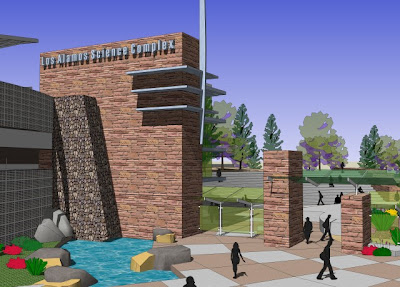
Los Alamos Science Complex

PEP Los Alamos’s conception of the proposed leased Science Complex.

Frank,
This note is in regard to the proposed Los Alamos Science Complex (LASC), a proposed $250 -$400 million (M) project planned for a 16-acre piece within TA-62, north of West Jemez Road. (Experience suggests it may be more realistic to modify this cost range to $300 to $500 M.)

Some 1,400 to 1,600 LANL workers are to be housed there.

This is to be a third-party-financed project built on government land. That is, a private developer would own the building and lease it to LANS, which would in turn bill the Department of Energy (DOE) within DOE’s operating funds for LANL.[1]

For the first time, a big hunk of LANL’s infrastructure would be owned by private real estate investors, about which more in a moment. The amount (and mission-critical quality) of space leased by LANL from private real estate interests, and DOE’s annual payments for same, would make a very big jump.

I am not sure whether it is DOE’s Office of Science, or NNSA itself, that would approve this lease – or from where exactly these funds would come each year. (Other approvals are also required.) It appears that annual lease costs would be in the general range of $28 M, the amount which would service a $400 M, 25-year mortgage at 5% interest.[2]

There would be three buildings in this complex: an office and laboratory building, a parking garage, and a secure area. A 3,332 sq. ft. office suite for the Associate Director for Science (currently, Terry Wallace) is included. There would be some 276,000 net square feet of unclassified space, 52,000 net square feet of secure space, and a parking space for everybody.

The April 11, 2008 RFP was posted here. Perhaps it still is. I don’t have it.

On or about May 6, 2008, LANS held a bidder’s conference.[3] On September 10 LANS announced its selection of Pacific Equity Partners (PEP) as the project developer.
Los Alamos National Security, LLC has selected Pacific Equity Partners Los Alamos Science Complex LLC (PEP) to develop the Los Alamos Science Complex in response to a request for proposal issued earlier this year.

LANS received a total of five bids from potential offerors to design, finance, construct, lease, and operate the proposed Science Complex -- comprised of two buildings and an adjacent parking garage at Technical Area 62 northwest -- located about a half mile west of TA-3….

"It is an honor and a privilege to be selected in a highly competitive process to build a world-class facility to advance science and technology for the United States of America," said Enrique Landa, managing partner of PEP…

Now that a developer has been selected, LANS will begin preparation of the final acquisition strategy plan for submission to NNSA. If all necessary approvals are secured, groundbreaking is projected in 2009. Construction is scheduled for completion in 2010 and researches are expected to begin moving into the new facility in 2011.
In October Terry Wallace described the LASC as “the poster child for the future of the Laboratory.”

Just last month (May 2009) LANS Director Mike Anastasio gave an upbeat assessment of LASC prospects.
“We’re well down the path on that process. We did an RFP, got bids and brought them forward for the science complex. We have support from the site office and NNSA. We’re getting really close. I can almost taste it,” he said.
Earlier this month (June 2009), we heard that Terry Wallace said he hoped to break ground on the LASC “before the end of this fiscal year.”
**********

Who is Enrique Landa and what is Pacific Equity Partners (PEP)? Who are their friends? How have they done business before?

(I am grateful to Darwin BondGraham for some of the following research. Remaining mistakes are mine.)

The Wall Street Journal described Landa as a
…Rancho Santa Fe, Calif., architect-turned-entrepreneur and son of a Mexico City architect. Messrs. Landa and [partner James] Simmons had put together packages of permits which they sold to construction companies to build a waste-treatment plant in Sonora state in Mexico [Agua Clara, LLC], and to upgrade treatment at a Mexico City plant.
Landa was also involved with a Tijuana maquiladora development, El Florido, and a golf course development in Maui. (See “Smelling money in sewage: Area firm hopes to sign no-bid deal with U.S. agency to treat Tijuana region's polluted water, then recycle it,” Mike Lee and Terry Rodgers, San Diego Union Tribune, November 13, 2005.)

Landa and Simmons created “Bajagua” out of Agua Clara, later adding partner Irwin Heller (a Boston lawyer, about which more below). Bajagua’s basic idea was to get the U.S. government to pay for building and operating a sewage treatment plant and associated conveyance infrastructure in Tijuana in order to prevent Tijuana sewage from polluting the ocean, especially after big rains.

There were no other bidders, in fact no bid at all. Creating that monopoly situation took a lot of money and influence applied in the right places over several years.

They paid to play.

Bajagua had major conceptual and engineering problems, such as failure to address a root cause of the sewage problem – lack of household plumbing in Tijuana.

In 2006 Nick Schwellenbach, then at the Project on Government Oversight (POGO), wrote a very good, in-depth review of Bajagua’s business methods, basically a sophisticated, broad-scale application of textbook techniques for corrupting government contracting.[4]

Landa and his colleagues were eventually stopped in California, just about the time they “won” the bid for the LASC. Bajagua cost Tijuana and San Diego years in the fight for clean water, however, because Bajagua-supported politicians held back all other more feasible options as favors to Landa, Simmons, Heller, and their friends.

The Wall Street Journal dissed Bajagua on January 29, 2007 (“Smell Test: How Politics Influenced A Big Clean-Up Deal", by Scot Paltrow). The WSJ didn’t pull punches: “Bajagua's tale shows how plans for federal public-works projects could be diverted by a small group of lawmakers, who were able to push contracts toward big campaign contributors.”

Paltrow says Bajagua
grew out of a partnership in the 1990s between James D. Simmons, a former San Marcos, Calif., city councilman who runs a consulting business, and Enrique Landa, a Rancho Santa Fe, Calif., architect-turned-entrepreneur and son of a Mexico City architect. Messrs. Landa and Simmons had put together packages of permits which they sold to construction companies to build a waste-treatment plant in Sonora state in Mexico, and to upgrade treatment at a Mexico City plant.
He describes Bajagua’s plumbing – expensive to build and to operate – like this:
Under Bajagua's plan to build a plant in Tijuana, 25 million gallons a day of raw sewage would continue to flow to the San Ysidro plant on the U.S. side where, as now, it would be treated only to primary standards. Then new pumps and pipes would send it back uphill into Mexico to the new Bajagua plant.

After treating the sewage there, Bajagua would send it downhill again, through yet another set of new channels, where it would cross the border a third time, to San Ysidro. Then it would be shunted into the ocean through the existing pipe. Eventually, the Bajagua plant would also treat an additional 34 million gallons of sewage directly from Tijuana, to be sent across the border to the ocean pipe.
Sewage was to be just the beginning. Bajagua’s really big profit center was apparently going to be a by-product of U.S. taxpayer investments, at least in part: drinking water, a scarce substance in Baja California.
By leveraging a U.S. government-funded wastewater treatment system pegged for Tijuana, developer Enrique Landa and consultant Jim Simmons aim to become the kingpins of recycled water in the parched state of Baja California.
(In a separate project, Landa also was and may still be pushing a desalinization project in southern California called “Nevagua.”)

The Bajagua scheme was apparently going nowhere until Landa and his associate James Smith traveled to Roswell, N.M., on October of 2002 to meet with Vice President Cheney and Republican contributor George Yates at a fundraiser.

In the years following this meeting, Bajagua spent over half a million dollars lobbying. They also discovered the civic benefits of repeated, large campaign contributions in key places.

One wonders what connections were made and what business opportunities later came to light among those who gathered at that Roswell fundraiser. When did the subject of the Los Alamos Science Complex come up? At that time or later, and with whom?
***********

PEP LASC’s incorporation file on the NM Sec. of State website lists three entities as limited liability partners: Pacific Equity Partners, LLC; Endol, LLC; and Enrique Landa.[5]

In addition to the for-profit PEP Los Alamos Science Complex LLC (PEP LASC), Landa has also created a nonprofit called the "PEP Los Alamos Fund.” (See also http://www.nmprc.state.nm.us/cgi-bin/prcdtl.cgi?4120929+PEP+LOS+ALAMOS+FUND). Nonprofits need not disclose donors. Under some conditions they can lobby. Visiting the executive branch isn’t even “lobbying” as the Internal Revenue Service uses the term in connection with nonprofits. What, exactly, are the purposes of this organization? Who are its funders if any?

The PEP Los Alamos Fund has Irwin Heller as a director, a Bajagua investor. Heller, we saw, is a Massachusetts lawyer, lobbyist – and a trustee of Tufts University (which is important, see below).

Like other Bajagua partners, Heller made maximum campaign contributions to several CA Reps. at opportune moments when Bajagua's no-bid contract was coming up for vote in the House.

He has also been giving money to NM politicians (Bingaman and Richardson) as well as to others, e.g. Sen. Murkowski (R-AK, Senate Energy and Water Committee) and Rep. Visclosky (D-IN, House Appropriations Subcommittee on Energy and Water Development).

He supported Richardson's presidential campaign. See http://www.campaignmoney.com/political/contributions/irwin-heller.asp?cycle=00: In fact Heller, then chair of the Tufts presidential search committee, once summoned then-DOE Secretary to his Boston law office, according to the Tufts Daily (“Sec. Richardson considered for presidential spot”).

Another thread is lobbyist David Godfrey, who has represented PEP LASC. His client list makes interesting reading, but perhaps the picture is already getting clear.
************

I have quite a few questions about this complex, but this post is too long already. Some questions may have already occurred to you.

One question is however too important not to mention: why are Landa, Heller, and Co. in New Mexico and at Los Alamos? I believe we can be very sure they would not be involved in this project without the strong likelihood of monopoly rents.

How far might this particular concept – “rents,” in the expansive sense of the term – go, and where might it go? I think far, but I don’t know where.

I am personally of the view there is more to this than just three buildings. Merely winning bids to provide buildings is not what these folks have been about.

Good luck,
Greg Mello


[1] NNSA’s contracts consume about 96% of its resources (See Competition - or Collusion? Privatization and Crony Capitalism in the Nuclear Weapons Complex: Some Questions from New Mexico (pdf) May 30, 2006). There is thus little fiscal space for further privatization of prime NNSA contracts. Overall business growth in NNSA services must occur either by growth of NNSA itself or by adding new layers of privatization, either “below” the ordinary prime contract (as we see in the case of the proposed LASC), or “above” it, as we see in the so-called “gorilla” weapons complex “integration” effort, where NNSA would basically pay a contractor to do what NNSA does now. In both cases overall business growth occurs by creating a market for goods and services not needed by NNSA before and in both cases agency and control pass from government and into private hands. (pdf) May 30, 2006). There is thus little fiscal space for further privatization of prime NNSA contracts, so overall business growth in NNSA services must occur either by growth of NNSA itself or by adding new layers of privatization, either “below” the ordinary prime contract (as we see in the case of the proposed LASC), or “above” it, as we see in the so-called “gorilla” weapons complex “integration” effort, where NNSA would basically pay a contractor to do what NNSA does now. In both cases overall business growth occurs by creating a market for goods and services not needed by NNSA before and in both cases agency and control pass from government and into private hands. The new “market” consists of new forms of overhead.

[2] DOE’s FY2010 request for LANL Office of Science activities is $68.1 M, a decrease from this year’s $74.4 M. If DOE’s Science account is going to pay for very much of this lease a significant costs must be shifted to it, or decreased somewhere else in the account by some means. An annual lease of $28 M is equal to the cost of about 180 LANL employees, fully burdened.

[3] “Lab makes another bid for new science complex,” Roger Snodgrass, Los Alamos Monitor, 5/4/08 or 5/5/08. This article is not available in the Monitor’s web archives.

[4] If you don’t want to read Schwellenbach’s extensive research article, RAW STORY provided the gist: “Whistleblowers allege influence peddling by members of Congress, VP in Mexico wastewater project,” by Miriam Raftery and Larisa Alexandrovna.

[5] We have not attempted to fully tease apart these companies and their partners.

Jun 21, 2009

Comment of the Week

I shouldn't be, but I am frequently astonished by certain, how shall we put this ... narrow-minded perspectives to which some people choose to limit themselves. Accordingly, this week's prize is awarded to a triplet of contributions that came in to the Committee Strengthens the Stockpile Stewardship Program post. The first one demonstrates the narrow perspective, in the sense that I classify conservative, Christian, right-wing flag-wavers as possessed of a certain narrow-mindedness. This is a good thing, however, because without it we would not have had the pleasure of reading the second two points of view.

Here we go. I hope most of you enjoy the contrast in perspectives as much as I did.

--

Long live the military-industrial complex!


6/20/09 10:00 AM

If it wasn't for the military industrial complex that you so happily berate, you wouldn't be posting on this blog as there would be no internet. The internet evolved from a DOD sponsored DARPA project back in the 70s to have a highly redundant communication system that could route its way around nuclear attacks.

If it wasn't for the military industrial complex, you probably wouldn't even be typing on a home computer. Computers evolved back in the 1940s and 50s from the US military's needs to have fast "calculating machines" that could compute artillery trajectories.

If it wasn't for the military industrial complex, the mutually assured destruction (MAD) standoff would never have occurred and the US would likely have been treated to a devastating WWIII sometime during the last 60 years.

If it wasn't for the military industrial complex, there would be little protecting your freedoms as a American citizen to vote and to have freedom of speech.

You owe the US military and its military industrial complex far more than you'll ever know. God bless the military industrial complex. It has done many good things for America and the world.

___________________________________


Rubbish, 12:51. Al Gore invented the internet; everybody knows that. It's just a bunch of tubes, anyhow -- even George Bush knows that.

Now, go count your guns or listen to Rush Limbaugh or something and quit bothering us with your right-wing blather.

and

12:51 does present a broad target, as a

Flag-waving, God-fearing Right-winger.

After you've unwrapped yourself from the flag, 12:51, be sure to go to church tomorrow and ask that all-knowing, all-powerful righteous Christian God of yours to bless America. Or at least the American military industrial complex. Maybe he'll accommodate you since he's probably got nothing better to do. I mean after all he's just been sitting around twiddling his thumbs since he finished creating the world & everything 6,000 years ago.

Later,

--Doug

Jun 19, 2009

Committee Strengthens the Stockpile Stewardship Program

For immediate release:
June 16, 2009
Contact: Loren Dealy (HASC) 202-225-2539

Committee Strengthens the Stockpile Stewardship Program

WASHINGTON, DC – Today the House Armed Services Committee took great strides to strengthen the Stockpile Stewardship Program. This is the program tasked with maintaining the safety, security and reliability of our nation’s nuclear weapons stockpile.

“H.R. 2647 builds on the work we did in the last Congress, and on the recommendations of the Strategic Posture Commission. It authorizes important funding increases to the Stockpile Stewardship Program, from scientific and experimental activities to infrastructure maintenance accounts,” commented Strategic Forces Subcommittee Chairman Ellen Tauscher (D-CA). “And to support the stewardship program, the bill establishes a new Stockpile Management Program to codify clear objectives and boundaries for maintaining our nuclear weapons capabilities. I am proud of the ways in which this bill sustains and strengthens the Stockpile Stewardship Program.”

“The STRATCOM Commanders have told us that they do not need new nuclear weapons, but they do need unimpeachable confidence in the capabilities we have,” said Representative John Spratt (D-SC). “This bill bolsters that confidence and ensures a robust deterrent without the need to resume testing.”

Representative Jim Langevin (D-RI) said, “By boosting the resources authorized to support stockpile stewardship and by establishing legal objectives and limitations for weapons stockpile work, H.R. 2647 brings badly needed clarity to the debate over our nuclear posture.”

The bill does the following:
  • Clarifies two broad objectives of the Stockpile Stewardship Program: to ensure that core intellectual and technical competencies are maintained and to ensure the nuclear weapons stockpile is safe, secure, and reliable without the use of underground nuclear weapons testing.
  • Establishes the Stockpile Management Program – a new program for weapons work in support of the Stewardship Program. The program requires that changes to the nuclear weapons stockpile may be made only if:
The following objectives are met:
  • Increase the reliability, safety, and security of the stockpile;
  • Further reduce the need for nuclear weapons testing; and
  • Reduce the future size of the nuclear weapons stockpile;
And only within the following limits:
  • Remain consistent with basic design parameters;
  • Include well understood components that can be certified without weapons testing; and
  • Fulfill current military requirements.
Amends existing requirements for an annual plan for the Stockpile Stewardship and Management Programs to require an assessment of the adequacy of the capabilities and workforce needed to execute the Stockpile Stewardship Program, and to require independent peer review in the annual assessment and certification process.

*** All provisions are subject to change pending final passage of H.R.2647 ***

###
[Download a 650 page searchable PDF of H.R.2647 here.]

Jun 18, 2009

Special Edition of Comment of the Week

Every now and then something happens around here that would likely just get lost in the noise. This comment speaks for itself, and carries an important message. It seemed appropriate to give it some visibility.

______________________________________


I don't know where else to post this, but I just wanted to say...

Adios LANL

After years of debate, I have finally decided I am taking my ball and going to play elsewhere. Today I quit my job at the lab.

I came to LANL straight out of grad school and have worked here now for several years. During that time, I regularly brought in multi-million dollars of funding each FY, scored in the top 3 on ORC scores in my group, blah, blah, blah. And during that time I can't say that I was allowed to do any science. In fact, LANL killed my scientific career -- many of my colleagues from other institutions pointed out how little of my potential I was being allowed to reach by staying here.

What Mikey and Terry and their LANS management croanies fail to realize is that LANL's reputation is SO bad right now, that most of the top universities are telling their students not to apply here. Many of them (a few that I have had relationships with) won't even let our scientists speak to their students anymore.

But the bigger problem to me is that LANS management just doesn't care. They don't care about getting science done or recruiting and retaining the best of the best. The only thing they care about are their bonuses and it doesn't matter to them who they step on or what science they crush along the way. Make no mistake, fellow bloggers. THEY DO NOT CARE. We can complain all we want on this blog, in the censored Reader's Forum, or wherever about how bad conditions have become. But the bottom line is that if those complaints don't put money into their pockets, it just doesn't matter to them.

So this junior staffer has had enough and is finally going to stand up and try to recreate a technical reputation. I am going someplace where I am being given the resources to do my job, not being punished for self-reporting cell phone incidents, and where I will actually be allowed to do science.

I would wish the LANS management "good luck," but from what I can tell, they were brought in to get LANL shut down and that is just not something I want to wish them well on.

Jun 14, 2009

Comment of the Week


It is somewhat reluctantly that I pick a COW this week, because there just was not that much that stood out in any positive sense. There were plenty of mediocre, shallow, or just plain immature contributions. I'm sure we will get a number of expert opinions as to why that is.

Among the more literate comments this week were several that discussed a perceived general decline in the quality of science associated with LANL under NNSA and LANS. Here are a couple of those from last week's Comment of the Week post:

I left LANL and went to work for a small company on the west coast. The company has a number of former LANL employees.

We have been told by a few potential customers that they were leery of doing business with us because "we had too many ex-LANL employees."

Believe me, LANL's reputation is in the toilet!

And

I don't think that we are getting the quality of PDs that we did five years ago. That has something to do with why our PDs are not getting good jobs. The smart PDs are going to places where science, not the Director's bonus, is important.

In a similar vein from the Lockout at TA-48/RC-1 post, one reader was interested in who was investigating last Wednesday's lockout event, to which 12:09pm replied,

"But if so, what agencies are the most interested?"

6/13/09 10:37 PM

No one is interested in Los Alamos anymore. You overestimate the importance of the place.


Finally, I've noted any number of wild, near-hysterical claims that LANL's continued existence was in some way essential to maintaining and/or establishing global nuclear security. Commenter 10:54am on the Radioactive Releases Documented at LANL post left a nice, clear, rational rebuttal to one of those comments:

Shutting down LANL and cleaning up its mess is not tantamount to unilateral disarmament. LANL's future in Plutonium pit manufacture has nothing to do with detection of a nuclear weapon in a container in the Port of Los Angeles. Geez-get a clue yourself.

LANL is not a necessary condition for non proliferation, although I understand your desire to keep your job, 8:26, and thus your rhetoric trying to defend LANL's continued operation. Fair enough. But please understand that many of us in the state think LANL's first priority should be to clean up its 60 year legacy of toxic dumping. To us, LANL's mess is more of an immediate threat than eliminating any role LANL might realistically play in stopping a mythical nuclear catastrophe in the Port of Los Angeles.


BTW, if you grew up in Los Alamos like I did, or worked there for any period of time (ditto) you really owe yourself a read of the CDC document that was released last week which details many of the accidents and chemical and radiological releases during Los Alamos' history. It is an eye-opener. The Los Alamos Historical Document Retrieval and Assessment report is available online at http://www.lahdra.org/pubs/pubs.htm.

Until next week,

--Doug

Jun 12, 2009

Lockout at TA-48/RC-1

Some of the latest comments on the Shocking News post are discussing a lockout at RC-1 Wednesday. Initially it was reported that foreign nationals were being turned away at the gate by guards. Later it was clarified that all non-Q cleared people were excluded due to a "classified exercise". Another commenter implies that the facility was searched, though there is no mention of law enforcement being involved.

So what's going on at RC-1? Could it be that something classified is missing and they didn't want uncleared people searching for it. Or perhaps RC-1 is one of the sites accidentally disclosed in the recent US declaration to the IAEA and security was doing a vulnerability assessment. What's your theory?

Jun 11, 2009

Radioactive Releases Documented at LANL

By Raam Wong, Albuquerque Journal Staff Writer

On Dec. 1, 1948, Los Alamos scientists detonated an explosive test that sent a radioactive cloud up over Bayo Canyon.

As he watched the plume drift over Los Alamos Mesa and settle into Pueblo Canyon, a lab health official observed that perhaps in the future it wasn't a good idea to set off explosions “without regard to wind direction and velocity.”

But such lessons were slow in coming in the early years of the lab.

A new report released this week identifies scores of accidents and chemical releases, as well as day-to-day operations from the lab's history that may have posed a public health risk.

The 558-page report is the culmination of 10 years of work by a team of researchers under contract with the U.S. Centers for Disease Control and Prevention.

The researchers lifted the lid on scores of dusty old boxes and reviewed millions of documents to piece together instances in which the lab released radioactive and toxic materials. The report's findings will be discussed during a June 25 public meeting in Pojoaque.

The report is already prompting calls on the federal government to use the records catalogued by the researchers to conduct a full-blown study of just how much radiation past generations of New Mexicans were exposed to.

“All the other major production sites within the (Department of Energy nuclear) complex have already had a dose reconstruction done,” said Joni Arends of Concerned Citizens for Nuclear Safety.

The report concludes that a dose reconstruction is feasible with the records available.

Among the report's main findings is that past Los Alamos operations released significantly more emissions “than has been officially reported or published to the scientific community.”

The investigators unearthed one memo written in 1956 that, if accurate, indicates the lab's DP West Building emitted more airborne plutonium than all of the government's plutonium processing facilities combined.

But it was during the infancy of the lab, when scientists were racing Nazi Germany in the development of the atomic bomb, that perhaps Los Alamos' environmental and safety measures were most lax.

The 85 rooftop vents at the D Building plutonium processing facility, for instance, spewed contaminated air with no monitoring and little filtering.

Meanwhile because of the geography of the Los Alamos area, most housing had to be built very close to the lab. One apartment complex was just 200 meters from D building, while a trailer park on the rim of Los Alamos Canyon may have been exposed to radioactive gases from nuclear reactors situated on the canyon floor.

“We've learned a lot in the last 60 years,” lab spokesman Fred deSousa said Tuesday. “Today, LANL is one of the best-monitored DOE sites in the country.”

The spokesman said lab environmental programs include extensive monitoring of air, soil, water and wildlife, and outside groups and the state Environment Department perform similar testing. “We have multiple safety nets,” he said.

The lab is also subject to an agreement with the state that requires the identification and cleanup of legacy waste over the lab's 40-square-mile property by 2015.

The report released this week states that access to classified documents at Los Alamos was the most difficult that the researchers had experienced at a DOE site due to several factors, including the Cerro Grande fire and security incidents involving LANL staff.

Still, the team says it was able to significantly expand the amount of documentation that is publicly available about past LANL operations.

Those records could come into play in two landmark wrongful death lawsuits recently filed by the survivors of former Los Alamos residents who were allegedly made sick by decades-old lab operations.

The report, which is available online, includes chapters on LANL reactors, tritium processing, beryllium use, residential housing developments and the incomplete picture of radiation exposures stemming from the world's first atomic bomb detonation in southern New Mexico.

“All assessments of doses from the Trinity test issued to date have been incomplete in that they have not addressed internal doses received after intakes of radioactivity through inhalation or consumption of contaminated water or food products,” the report states.

The report also provides a chronology of past accidents and other potential release incidents, as well as a prioritization of which events may have posed the most risk to the public.

The Los Alamos Historical Document Retrieval and Assessment report is available online at http://www.lahdra.org/pubs/pubs.htm. A public meeting on the report is set June 25 from 5-7 p.m. at the Buffalo Thunder Resort and Casino in room Tewa 3.

Gold theft investigation at LANL nearly complete

By CAROL A. CLARK, The Los Alamos Monitor

The Investigation into an attempted gold theft that occurred in late March at Los Alamos National Laboratory's TA-55 is close to wrapping up.

“We expect the investigation to conclude most likely by the end of the month, at which time it will be referred to the U.S. Attorney's Office in Albuquerque for a decision on whether to prosecute,” FBI Agent Todd Hulsey said Thursday.

Hulsey mentioned it appears the employee acted alone in his attempt to steal gold from his workplace at TA-55.

He was discovered attempting to exit his area with an estimated $2,000 worth of gold shavings inside a plastic sandwich bag hidden in his clutched fist.

In his attempt to smuggle out the gold, the employee triggered the first of eight layers of security mechanisms and was stopped dead in his tracks inside the Plutonium Processing Facility.

The man has reportedly worked at Los Alamos National Laboratory for more than 20 years.

“The individual is no longer employed at the laboratory,” said Public Affairs Director Jeff Berger in a recent interview.

Laboratory personnel conducted an inventory following the incident to determine if anything else was missing.

“The inventories have been completed without issue,” Berger said.

The name of the individual will be released if the U.S. Attorney’s Office determines sufficient evidence exists to call for his arrest.

The gold shavings seal cracks in platinum-lined containers used for plutonium-related work, according to information relayed to the Monitor.

The Plutonium Facility Site at TA-55 is located on 40 acres about one mile southeast of the central technical area at TA-3, according to information on the Los Alamos Study Group website.

The main complex has five connected buildings: the Administration, the Support Office Building, the Support Building, the Plutonium Facility and the Warehouse.

The Nuclear Materials Storage Facility is separate from the main complex but shares an underground transfer tunnel with the Plutonium Facility.

Various support, storage, security and training structures are located throughout the main complex.

Jun 10, 2009

Congress Wants To Give Nuclear Agencies a Nudge

By Kerry Young and Caitlin Webber, CQ Staff
June 6, 2009

No matter how you pronounce it — noo-kleer or noo-kew-leer — two debatable points emerge:

• The government needs more nuclear scientists — or maybe not, and;

• Government agencies that oversee nuclear operations need more money — or maybe not.

And therein lies the problem for Congress as lawmakers decide how much money to give those agencies in the next year.

Senate appropriators who oversee funding of the Energy Department said that the White House hasn’t allowed enough money for fiscal 2010 for certain nuclear programs, but one nuclear agency official told them they could hold off on increases for a year.

Sen. Byron L. Dorgan , D-N.D., chairman of the Senate Energy-Water Appropriations Subcommittee, said at a panel hearing that the administration stinted in its fiscal 2010 request for the National Nuclear Security Administration (NNSA), the agency that oversees the U.S. nuclear arsenal and also helps prevent terrorists around the world from getting atomic weapons.

Senate appropriators questioned the fiscal 2010 request of $9.9 billion for the NNSA, which has duties ranging from dismantling U.S. nuclear weapons and maintaining the remaining stockpile, to aiding in top scientific research and securing uranium supplies in countries such as Kazakhstan, Libya, Serbia and Vietnam,

“The fact is that NNSA is going to have a very active future,” Dorgan said at hearing, and ticked off some of the challenges facing NNSA, including President Obama’s goals for securing vulnerable nuclear materials around the world and North Korea. At the same time, the United States is working toward further reducing the size of its nuclear arsenal.

“This will require more dismantlements, and that will require more funding,” he said. The United States is engaged in a review of its policy on atomic weapons, with a Nuclear Posture Review (NPR) report due out in early 2010 — but the NNSA cannot keep its activities in a holding pattern, especially when doing so could cause it to lose highly trained scientists, the appropriators said.

However, NNSA Administrator Thomas D’Agostino said the agency wants to keep its programs near current levels in anticipation of the Defense Department’s release of the NPR, which will set the course for the nation’s nuclear stockpile.

Meanwhile, at the NTNF...

The appropriations hearing came on the heels of a Government Accountability Office report stating that nuclear scientists are in short supply, and the government agencies responsible for investigating a nuclear attack are uncoordinated and unprepared.

In portions of a declassified report released June 1, the GAO said the National Technical Nuclear Forensics (NTNF) program, comprised of several agencies and coordinated by the Homeland Security Department, needs a better plan to recruit and train nuclear forensics experts.

If a nuclear attack were to take place, these experts would be responsible for identifying the type, material and origins of the device used.

The GAO also cautioned against proposed budget cuts that would affect nuclear forensic programs within the NTNF agencies.

“A comprehensive and responsive nuclear forensics capability is critical to the national security of the United States because it provides a deterrent to other countries that may provide nuclear materials to terrorists and can help attribute a nuclear or radiological event to specific perpetrators,” Gene Aloise, the director of natural resources and environment for the GAO, wrote in the April 30 report.

Tension and ‘Bad Ideas’

At the hearing, Dorgan and Robert F. Bennett of Utah, the ranking Republican on Senate Energy-Water Appropriations, referred to tensions that they detected between the NNSA and the Office of Management and Budget. “You are not ultimately responsible for this budget request, but you have nonetheless come here to answer questions about it,” Dorgan told D’Agostino, and referred to official internal communications between NNSA and the OMB.

Bennett told D’Agostino he understood the “frustration” that agency officials sometimes face in working with OMB and then having to defend the resulting budget plans. Still, Bennett criticized the fiscal 2010 request that D’Agostino, who was appointed to his job in 2007, was there to defend.

“I don’t think the budget provides adequate funding to the scientific community,” Bennett said. “I think it falls flat.”

Dorgan also asked NNSA to persuade OMB to drop its current consideration of moving responsibility for the U.S nuclear stockpile to the Pentagon, a proposal that’s been considered and rejected in the past.

“It reminds me that bad ideas have unlimited shelf life here in the nation’s capital,” Dorgan said. “This is a bad idea that has been debated and long ago discarded.

“Also, bad ideas are bipartisan. If you get a chance to talk to OMB, would you suggest that they close the cover of that book and move on?”

“Yes, sir, I’d be glad to,” replied D’Agostino.

Jun 9, 2009

Positioning the Laboratory to meet global security challenges

-------- Original Message --------
Subject: LANL-ALL2287: Director's Outlook
Date: Mon, 08 Jun 2009 12:25:21 -0600
From: Distributions
To: LANL-ALL@lanl.gov


June 8, 2009

Positioning the Laboratory to meet global security challenges
President Obama announced in Prague earlier this spring that he and his Administration will work tirelessly to “ensure that terrorists never acquire a nuclear weapon.” In order to meet that goal, he announced “a new international effort to secure all vulnerable nuclear material around the world within four years.” He added, “We will set new standards, expand our cooperation with Russia, pursue new partnerships to lock down these sensitive materials.”

We see frequent evidence that the challenge of proliferation is not shrinking but in fact growing. We were reminded of this most recently by news reports that North Korea had attempted yet another nuclear test.

As you all know, the Laboratory has for decades played a significant role in what to date we have called Threat Reduction. Threat Reduction is not one mission but many, providing support to the NNSA’s nonproliferation efforts, to the Department of Defense, Department of Homeland Security, and the broader intelligence community. Among other areas, the Lab has been a leader in developing technologies to detect and identify nuclear materials, as well as safeguards technologies that ensure that materials are secure and accounted for.

The work that LANL and the other NNSA laboratories do in this area is well recognized, and elements of that work were cited in the recent report of the bipartisan Strategic Posture Commission. In the area of nuclear weapons intelligence analysis, the Commission specifically noted that “For decades, the laboratories have provided unique insights into foreign weapons programs because of their ability to bring weapons design expertise to the study of such programs. As concern about nuclear proliferation and terrorism has grown over the last two decades, this expertise has been in rising demand.”

Given the importance of these mission areas to the Laboratory’s future and their increasing emphasis by the Administration, I have elevated the level of the Laboratory’s leadership position in this area to principal associate director, or PAD.

This new organization, which includes programs in nonproliferation, intelligence support, defense, counterterrorism, and homeland security, will lead the Laboratory’s initiatives to meet the nation’s global security challenges.

In the coming weeks, I will formally announce my selection for the PAD Global Security.

Lab Director Michael Anastasio


Contact: directorsoutlook@lanl.gov

Director Anastasio addresses the Laboratory workforce in a periodic message.

Director's Outlook: 20090607551

Jun 7, 2009

Shocking News!

---------------------------- Original Message ----------------------------
Subject: Note from ADEPS
From: "Susan Seestrom"
Date: Fri, June 5, 2009 5:53 pm
To: adeps-all@lanl.gov
Cc: "Terry Wallace"
mneu@lanl.gov
arb@lanl.gov
wxg@lanl.gov
--------------------------------------------------------------------------
Colleagues,

Cyber Security

Cyber security continues to be a concern at the Laboratory. There has been a dramatic increase in targeted phone calls (those targeting a specific person). Recently examples are calls claiming to be from local banks, local medical facilities. The caller knows your name and telephone number and solicits personal identifying information. Do not give out your personal information. If you think it could be legitimate, call back to the normal phone number for the organization if it reputes to be one you deal with.

We have also been hit by war dialing - over 40,000 calls this last weekend. Phone calls that solicit PII or other suspicious information should be reported to the SIT (Security Inquiry Team 665-3505) The lab have moved to proactive defense, so let NIE (Network Infrastructure and engineering) Organization (667-6430) know if you have a legitimate requirement to collect information through phone calls.

We continue to see new threats involving email. The Lab received 3.664M emails last month from external resources; NIE stripped 1.728M of these emails because they appear to be SPAM. They also stripped between 100 and 2000 emails a days for virus content in the last month

A new threat: targeted nation-state spearfishing. One example from this week: a collaborative community of researchers (internal + external) with a shared email list was targeted. Someone appearing to be known to the group solicited information from the members of the lists about z number or password. A few people responded. When malicious outsiders have this information it can be used to compromise our network security.

Report emails that solicit information such as Z numbers, passwords, or PII to the SIT. NIE is proactive in shutting down external URLs/IP addresses solicit information: please let them know if you are using these types of services.

Privileged Computer Access for Non-US Citizens

Once again I request your patience in working through the problems posed by the new computer system designed to track, justify and approve computer access for Non-US Citizens. The implementation has been very rough, as I know from the amount of time it has taken me to approve them. I have spent quite a bit of time working with Tom Harper and Nat Farnham in CIO to resolve the numerous problems we have encountered. We received a one time extension to the process. This means that we have until June 12th to either obtain approval for privileged access - or to remove that access.

AS of this morning there were about 130 cases in which the host had not submitted the request for approval thru the PUAR system. Many of these may not really need to be submitted (because that system was mistakenly identified as needing privileged access, for example). My plea is that all hosts/co-hosts of foreign nationals ensure that the data has been entered into the PUIAR system for EACH SYSTEM to which your FN needs privileged access. Your division leaders have the complete data base on what is in this system and they can provide information if you are unsure that state of your requests.

I would also like to remind you all that the laboratory has been negotiating with NNSA at the highest levels to develop an approval process for privileged access on appropriate machines for Foreign Nationals from countries the Department of State has deemed "sensitive" (http://int.lanl.gov/security/isec/fva/countries.shtml). At this time we have not received final approval on this process - Terry Wallace is personally strongly engaged on this and he is optimistic we will have a process, but it is not yet approved. Until such an approval is obtained we have until June 12th to remove PA accounts for foreign nationals on the various machines/clusters that have not been re-approved by this new PUAR process. This will unfortunately require us to begin removing such accounts, including all those for sensitive FNs. We will continue to work toward an approval process for the needed tools for all our workforce to accomplish their work.

I understand this may have very significant impacts to the productivity of many of our foreign national employees and visitors. We must also comply with the policies that NNSA has laid out for us. Be assured we will work tirelessly to find ways to mitigate the impacts of this policy.

Electrical Safety Improvement

Safety incidents continue to be a grave concern of mine; one of our divisions has an incident almost every week and I am concerned that the sheer volume is a warning that a serious incident could happen at any time. Please, please ensure you are trained and authorized to perform work or tasks, and be vigilant and careful when you perform them. In particular - student mentors ensure your students are properly supervised, that they have appropriate training, and they understand what work they are allowed to do. Students - be sure your understand what you have been authorized to do - and if you have ANY questions ask you mentor (and if she/he is not available ask your team leader or group leader).

Right now the Lab is emphasizing electrical safety and we are asking that all of you take some actions to raise your awareness regarding responsibilities, qualification and training, to assure your electrical equipment is safe, and that IWDs adequately reflect potential dangers. This is why:

There have been twelve electrical incidents this FY:

* There have been 6 electrical events in March 2009.
* Two were serious shocks, to programmatic workers.
* Three resulted from work control omissions, using a voltmeter on energized circuits (Mode 2 work) without authorized work control (without a proper IWD)
* Three involved workers not qualified.
* Two involved unlisted, unapproved electrical equipment.
* One involved inferior quality equipment.
* One was a deenergized phone line struck during excavation.
* Two were clearly Human Performance related
* At least one could have resulted in a fatality if luck had not been on our side

Now let me tell you about another incident of concern that occurred just this last. On May 27, 2009, the Science Technology and Operations FOD declared a management concern relative to work management and worker qualification discrepancies identified on a pulsed magnet replacement. On May 21, 2009, the Materials Physics and Applications National High Magnet Field Laboratory (MPA-NHMFL) acting group leader became aware that a NHMFL student had inadvertently removed a cable connected to the cell safety switch while replacing a pulsed magnet in Cell 3 of the NHMFL. The cell safety switch, an engineering control, isolated the magnet from the 1.6 mega joules (MJ) capacitor bank energy source. A NHMFL technical staff member had tasked the student to replace the magnet due to its failure. Preliminary review found the magnet replacement work had not been properly authorized. The review identified the following discrepancies with the pulsed magnet replacement work:

* The MPA-NHMFL student has been in the NHMFL technical program for about two years. He had been assigned a mentor, but due to unusual circumstances, his mentor left and another mentor had not been re-assigned to the student.
* Work requests for students are processed through their supervisor which is usually a mentor. In this case, the student performed the magnet replacement work alone in Cell 3 of the NHMFL. The work request had not been processed through the student's supervisor; therefore, MPA-NHMFL management was unaware of the work until it was reported.
* Integrated Work Document No. NHMFL-35-124-l105-1, "Capacitor Control and Maintenance," defined the hazards and mitigating procedures for performing maintenance, repair or modifications of capacitor bank system. The IWD did not specifically address magnet replacement and the student had not been authorized to perform work under this IWD.
* Any maintenance, repair, or modification to the capacitor bank system must be performed by a qualified electrical work. The student, though extensively trained, was not a qualified electrical worker.

The issues of work authorization and appropriate supervision have the potential to cause problems anywhere in our organization. We are fortunate that the magnet lab center leader was well versed in the hazards of pulsed power, that the issues surrounding this event were appropriately brought to his attention, and that he responded with appropriate urgency. Please think about how you or your colleagues might be placed at risk due to similar causes and take action if you find some.

Gordon Receives NNSA Safety Professional of the Year Award!

We are fortunate to have the best chief electrical safety office in the complex! Lloyd Gordon received the NNSA Safety Professional of the year award for 2008. Gordon displayed outstanding leadership in electrical safety, both at the Laboratory and across the Department of Energy, said Tom D'Agostino, NNSA administrator. He is a primary author of the Electrical Severity Measurement Tool, which is now used across the DOE complex to categorize and report electrical incidents. Gordon also provided leadership and technical guidance to nearly 150 group and division electrical safety officers and developed and delivered training to thousands of Lab workers.

Safe Drinking Water

AD Bob McQuinn presented information on drinking water at our LANL team meeting on May 29. In April, LASO directed that bottled water is an unallowable expense if safe drinking water is available. LANL and LA County both comply with the Safe Drinking Water Act of 1994. In 1993 LANL extensively evaluated drinking water and found trace levels of lead due to soldered joints in some water fountains. All of these have been removed from service. Since the LASO direction, safe drinking water access has been defined as a drinking fountain or kitchen sink. Access to only restroom supply is not considered acceptable. Bottled water can only be supplied if access to safe water is not available, and the FODs will work these issues. The Lab is analyzing water in buildings where there is some suspicion there might be a problem; none have been found. Although the origin of this issue was in the LASO determination on unallowable cost, this is a reasonable decision. for many other reasons. At a time of budget pressure there is no reason to spend money buying water when safe drinking water is available to us. Using the public water supply is more environmentally conscious than buying water and transporting it from other locations.

I wish you an enjoyable weekend and a safe and productive week!

Susan

--

Susan J. Seestrom, Ph.D.
Associate Director for Experimental Physical Sciences
Mail Stop A106
(505) 665-4454 FAX (505) 665-1293

Comment of the Week

This week our COW examines the relationships between certain NNSA individuals and the corporations that benefited from the LANS and LLNS contract awards. From the Comprehensive Nuclear-Test-Ban Treaty: Updated “Safeguards” and Net Assessments post, 11:02am asks the following question:


Why do you think D'Agostino put Bechtel and BWXT in charge of LANL and LLNL as for-profit entities and that he's constantly pushing things like Six Sigma?

He knows what he is doing. His buddy Smolen has recently made out well with his new position and D'Agostino also expect[s] to see a nice return on his "investment" in Bechtel and BWXT once he leaves NNSA.

Follow the money. It's not about science or national security any more in the NNSA complex


The "Smolen" referred to in the comment is Robert Smolen, former NNSA deputy administrator for defense programs. Smolen has since left the nuclear agency to become a senior national security fellow at Lawrence Livermore's Center for Global Security Research.

What do you think? Payoff for government-assisted profiteering, or just your typical, normal every day corporate America business as usual?

--Doug

Jun 6, 2009

LANL Official Defends Neutron Center

By John Fleck, Albuquerque Journal Staff Writer

A top federal nuclear official this week endorsed continued operation of a Los Alamos National Laboratory research complex, splitting with Obama administration budget officials who had said the Los Alamos Neutron Science Center was no longer needed.

Tom D'Agostino, head of the National Nuclear Security Administration, told members of a Senate subcommittee that the Neutron Science Center is important to maintaining U.S. nuclear weapons.

The Office of Management and Budget, in a budget-cutting report released last month, said the center's "usefulness ... is ebbing," and recommended terminating plans to refurbish the machine's aging components.

The proposed $19 million funding reduction was one of 121 cuts nationwide singled out by the Obama administration as evidence of its commitment to reduced federal spending.

Members of New Mexico's congressional delegation have pledged to fight the cut, calling LANSCE vital for Los Alamos and the nation's nuclear weapons program.

The machine makes X-ray-like images of nuclear weapon parts and does other related research. Without the money for refurbishment, the three-decades-old machine's life is limited, according to a Los Alamos report.

D'Agostino, testifying Tuesday before the Senate Energy and Water Appropriations Subcommittee, disagreed with the budget report's assessment of LANSCE's future usefulness.

He said decisions about LANSCE's long-term future will have to await completion of a Pentagon report on the future of the U.S. nuclear stockpile.